


Transport - Rail
Before The Railways
Before the railways arrived, many industrialists built waggonways. These were simple horse-drawn railways on wooden rails used to move goods. They were common in the coal fields of North East England. When John Dixon of Sunderland bought Dumbarton Glassworks in 1750, he built a waggonway from Woodside Colliery, Knightswood, to Yoker. This allowed coal to be sent to Dumbarton by river. The Woodside to Yoker Waggonway did not last long and closed by 1775. Later, coal was transported by the Forth and Clyde Canal.
The Coming of Rail
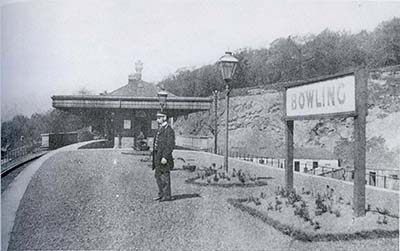
As railways grew across the UK, West Dunbartonshire developed quickly. Many companies built lines in the area. The Caledonian and Dunbartonshire Junction Railway, also called the Dumbarton and Balloch Joint Railway, opened in 1850. It ran from Bowling to Balloch Pier. This railway let travellers leave the Clyde Steamers at Bowling and travel by rail to Balloch to catch the Loch Lomond Steamers. This saved time and helped the growing tourism industry. By 1855, the Glasgow, Dumbarton and Helensburgh Railway met this line at Dalreoch and Bowling. This allowed travel by rail from Glasgow to Balloch without using the river.
The Forth and Clyde Junction Railway opened in 1856 between Balloch and Stirling. It was mostly rural. From Balloch it went past Dalmonach and Jamestown before moving east through West Dunbartonshire. Caldarvan Station, near Gartocharn, was the last station in the area. The line continued to Stirling through small stations like Drymen, Balfron, and Kippen. Many stations were far from the villages they served. For example, Drymen Station was in the smaller village of Croftamie. The line was never very profitable.
As industry grew in eastern West Dunbartonshire, the railway became needed to move goods and people. The Glasgow, Yoker and Clydebank Railway, approved in 1878, connected with Glasgow’s railway network at Whiteinch and went to Clydebank and Dalmuir. It let workers from the J. and G. Thomson Shipyard travel from their old homes in Govan to the new shipyard in Clydebank via rail and the Stobcross Ferry.
The last major 19th-century rail project was the Lanarkshire and Dunbartonshire Railway. It was approved in 1891 and opened in stages between 1894 and 1896. It connected Glasgow at Possil Junction to the Caledonian and Dunbartonshire Junction Railway at Dumbarton Central. The line crossed West Dunbartonshire through Clydebank, including the scenic Clydebank Riverside Station and Bowling. Bowling had two railway stations, and travellers could reach Helensburgh, Loch Lomond, and the new West Highland Line.
Decline
The 20th century was harder for West Dunbartonshire’s railways. In 1934, years before the Beeching Cuts, the Balloch to Stirling line closed to passengers. Freight services were gradually withdrawn by 1965. Road transport and the decline of industry meant less need for rail. Other stations closed too, including Clydebank Riverside, Kilbowie, Dalmuir Riverside, the original Old Kilpatrick Station, and one of Bowling's stations. Some tracks were removed, others left to decay. Decline in Loch Lomond steamer traffic led to Balloch Pier Station closing. Balloch Central was later replaced by today’s Balloch Station. Today, many old rail routes are still visible. Some are cycle tracks, others reminders of the old railways. Examples include the Lanarkshire and Dunbartonshire Railway Bridge over Dumbarton Road, Clydebank, and old tracks in Dumbarton, Old Kilpatrick, and Cable Depot Road, Clydebank, where a line used to enter John Brown's Shipyard.