Budget Conversations
On 16 December 2026 and 3 March 2027, West Dunbartonshire Council will meet to agree its budget. In this Budget Conversation, we are asking residents, businesses, and community partners to share their views on the services that are most important to them. This feedback will inform budget proposals for 2027/28.
We know that households across West Dunbartonshire are facing huge financial challenges. Rising prices make this a cost-of-living emergency. West Dunbartonshire Council also continues to face its most difficult budget pressures for many years.
We are experiencing large increases in inflation which is driving up costs and prices for energy, fuel, and materials.
Our 2027/28 budget gap – which is the difference between our income and the cost to run our services - currently stands at £10.906 million, rising cumulatively to £44.029 million by 2030/31. This position may change after we have worked through the implications of the local government’s final budget settlement, expected in December.
We manage the Council’s finances responsibly and plan carefully to meet current and future financial challenges. Our financial outlook has been exacerbated for a variety of reasons but primarily due to bank interest rates and general inflationary pressures which are not reflected in the totality of income available to the Council to offset expenditure.
We have had some insight into to what matters most to you and your communities through responses gathered in our recent Citizens Panel. We have been guided by what you have told us about your experiences living in West Dunbartonshire.
We now want to hear your views on your priorities across several key areas. Together, all this feedback will help inform our decisions during the budget process.
The budget setting helps balance the main council budget; however, this does not include the annual rent setting consultation and a separate consultation with all tenants will be carried out later in the year.
The survey will take up to 20 minutes to complete depending on the detail you provide in your response.
The survey will remain open from 11 May until 13 July 2026.
About the Council
Our vision is to lead positive change – delivering services which build on the strengths and resilience of our neighbourhoods and supporting all residents to fulfil their individual potential and that of their communities. We are focused on tackling inequality and disadvantage, working with our partners locally and nationally, investing in people, using our resources wisely, speaking up for West Dunbartonshire, and being inclusive and open. These are laid out in our Strategic Plan 2022-27.
2026/27 Investments and budget savings
West Dunbartonshire Council is on the frontline of supporting the most vulnerable people in our communities. We are committed to helping them and their families, for 2026/27 we have made additional investment in the Health and Social Care Partnership and WDLT.
Summary report of our investments and savings.
Where our money comes from
In 2026/27, 14% of the Council’s funding for services will come directly from council tax, with the rest coming from charging for services, government grants, non-domestic rates, and use of limited Council reserves.
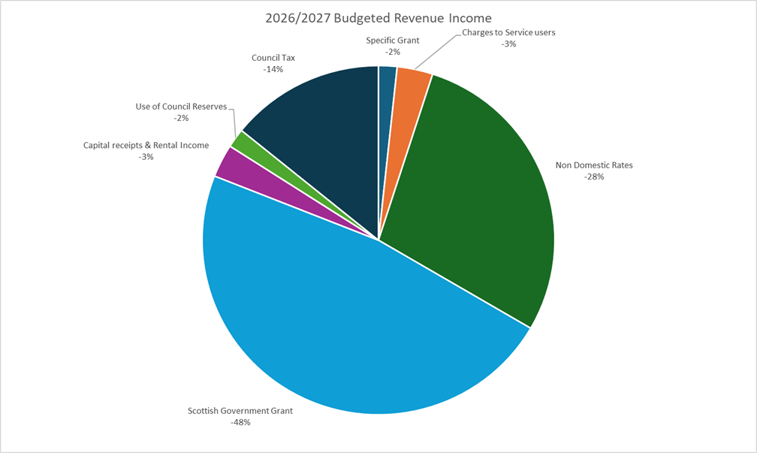
Most of the funding can only be used for the purpose it has been given and cannot be allocated to day-to-day Council spending.
Revenue Budget: this is income that pays for the day-to-day delivery of Council services. It is predominantly made up of Scottish Government grants, Council Tax, Non-Domestic rates and charges for services; this budget is the main focus of the budget conversations for 2027/28.
Capital Budget: Capital projects are funded from a variety of sources including directly from the Scottish and UK Government (for example Levelling Up Funding) of which some is ring-fenced for specific projects. There are also some externally sourced grants or income from capital receipts. The remainder needs to be met through borrowing.
Examples of current capital projects are the regeneration of town centres including Glencairn House. This is a historic building which will be refurbished and put into use again. This is funded from Levelling up Funding which is ring-fenced for the specific purposes it was awarded and there is funding to improve streets and cycle lanes as well as investment in roads and flooding works. The production of the infrastructure project at the Exxon site at Bowling whereby the creation of a relief road alongside the A82 at Milton is now underway and progressing well.
Ring-fenced funding: this is money that comes various sources (mainly Scottish Government grants) that must be used on specific things such as healthcare and teaching. The Housing Revenue Account (HRA) is also ring-fenced, this is money that comes from household rents and can only be spent in housing areas.
Income from Council Tax
In 2026/27, we agreed to an 7.8% increase in Council Tax which provided £3.541m of additional resources to balance increase the 2026/27 budget.
The 7.8% increase means that the Band D Council Tax Rate has increased to £1,681.53.
The table below provides an example of how much additional income would be generated if a Council Tax increase is agreed in 2027/28.
Additional Income
2027/28 (based on Council Tax Band D)
| Increase in council tax | 2027/28 Annual charge |
Additional cost per household per week | Additional cost per household per year |
Total income generation for the Council (all council tax bands) |
|---|---|---|---|---|
|
5% |
£1,765.61 |
£1.61 |
£84 |
£2,490,000 |
|
10% |
£1,849.68 |
£3.23 |
£168 |
£4,980,000 |
|
15% |
£1,933.76 |
£4.85 |
£252 |
£7,470,000 |
What we spend on council services
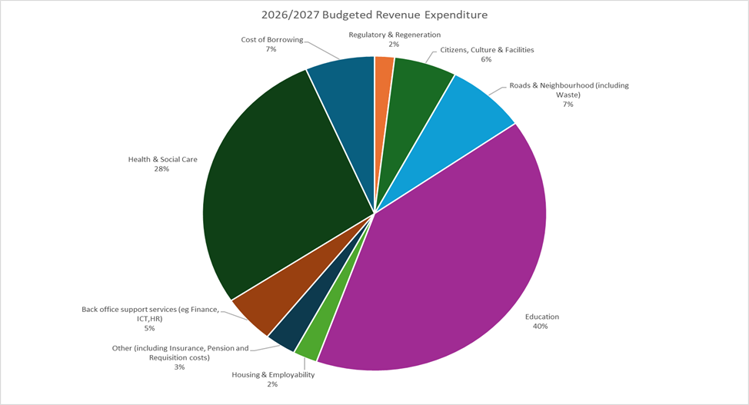
In 2026/27, the Council will spend just over £313 million on services. This is our total net expenditure budget. In addition, we will also spend approximately £120 million on capital projects; our capital programme includes investing in the regeneration of our town centres and infrastructure, new school buildings, new energy-efficient social housing, and other service needs reflecting the Council’s priorities.